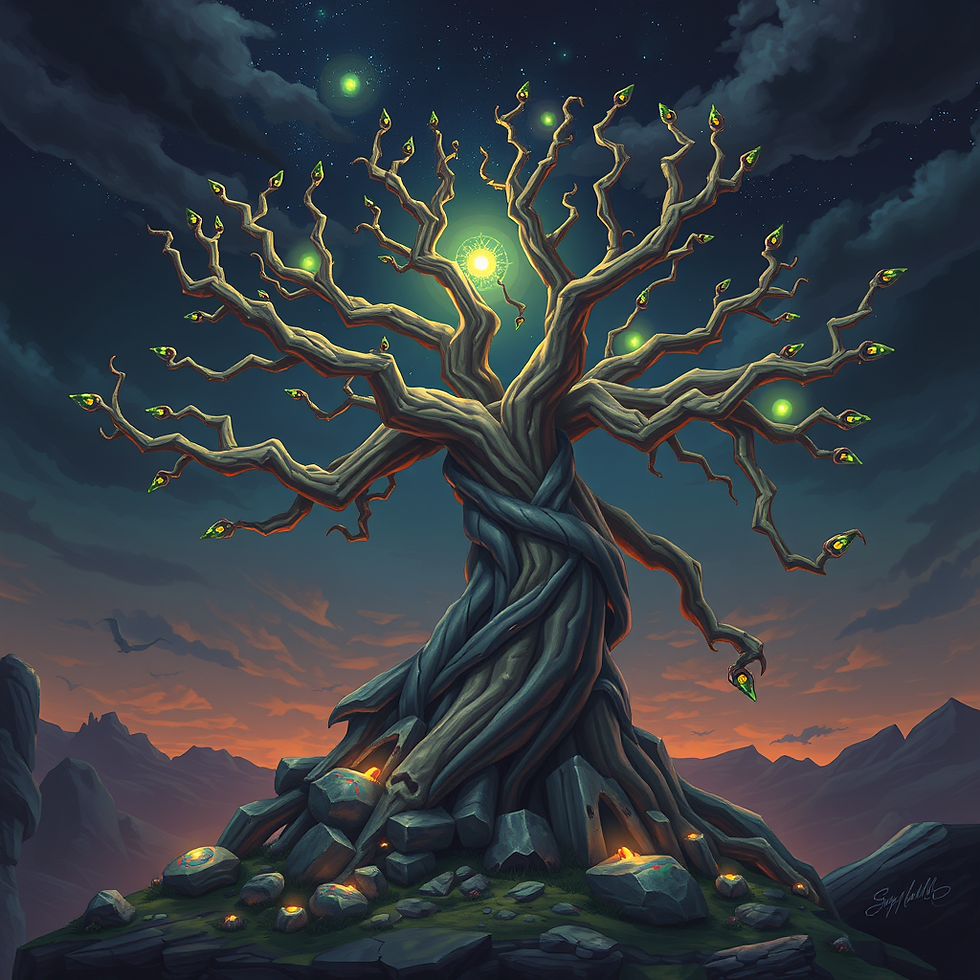
Yggdrasil and The Jewish Tree of Life, More in Common than Most Think.
- Tara Melchizedek
- Jun 22
- 5 min read

At first glance, the cosmology of the Norsemen and the deeply abstract, metaphysical doctrines of Jewish mysticism, called Kabbalah, which means to receive directly the light of Torah, seem worlds apart. One gives us Viking sagas, dragons, and the twilight of the gods; the other gives us the esoteric meditations of medieval rabbis attempting to understand the infinite light of the Creator.
Yet, when we look at the central icon of both traditions—the cosmic tree—the mythological and esoteric similarities are striking, that's because both are based on spiritual truth and the psyche of the people, their own symbolism is different than the Old Testament because their culture was different. In Norse myth, the Tree of Life is called Yggdrasil, and the immense World Ash. In Kabbalah, it is Etz Chaim, the Tree of Life. Both are far more than just "trees"; they are structural maps of consciousness, creation, and destiny.
Let's dig into the deep, esoteric overlap between these two profound spiritual frameworks.
1. The Axis of the Universe (Interconnectedness)
In Norse cosmology, Yggdrasil acts as the Axis Mundi, the central pillar of reality. Its roots, trunk, and branches tie together the Nine Worlds—spanning the heavens (Asgard), the earthly realm (Midgard), and the underworld (Hel).
Kabbalah mirrors this concept of a vertical, interconnected cosmos and has 10 spheres, plus a hidden one, only a few initiates discover. The Kabbalistic Tree of Life is a blueprint of existence the spheres are called Sephirot and represent divine emanations. Just as Yggdrasil spans different realms, the Tree of Life spans four distinct "worlds" of creation in Jewish mysticism:
Atziluth (Emanation) - The highest divine realm.
Briah (Creation) - The realm of intellect and archangels.
Yetzirah (Formation) - The realm of emotions and angels.
Assiah (Action) - The physical, material universe.
In both traditions, the physical world we inhabit is not isolated. It is the grounding point (Midgard in Norse myth, *Malkuth* ( Earth) or "Kingdom" in Kabbalah) that is inextricably linked to higher spiritual dimensions. What happens in the roots affects the branches; what happens in the divine realms metaphysically creates the foundation for the manifestation of our physical reality multidimensionally.
2. The Pursuit of Wisdom Through Sacrifice: Christ Yeshuah taught us to pick up our cross and follow Him, not to be afraid of losing our lives, “to not love our lives to the death” and seek wisdom tried by fire. All of these and many more verses convey the news to embrace suffering or be willing to in order to achieve true wisdom, but that it begins when we Fear God's judgment and not the judgment of other people more.
One of the most famous myths surrounding Yggdrasil is Odin’s sacrifice. To obtain the wisdom of the runes, which was their externalized wisdom teachings and layer alphabet, just like Hebrew has—the symbols contain the fundamental archetypal secrets of the universe. Just like Christ set up his own murder, by giving Judas permission to betray Him, Odin hung himself from Yggdrasil for nine days and nights, pierced by his own spear, refusing food and water. This act symbolizes that true, cosmic wisdom requires profound personal sacrifice and the "death" of the old self. Divine Christ Consciousness comes into the world and gives, teaches and initiates at the cost of experiencing the suffering in the world.
Kabbalah requires a strikingly similar esoteric ascent. For a mystic to truly understand the Divine, they must spiritually "climb" the Tree of Life. This journey from the lowest sphere (Malkuth) to the highest (Keter, or Crown) is not easy. It requires the mystic to cross the Abyss and achieve a state called Ayin (Nothingness/Ego-death).
Both traditions teach that you cannot attain the highest knowledge of the universe while clinging to your mortal ego. The Norse god bleeds on the tree to grasp the runes; Christ bled on the tree to offer salvation and spirutual truth to Spiritual Israel and the Kabbalist empties their ego to become a vessel for the *Or Ein Sof* (the Infinite Light), a state I call being Christed.
3. Destiny, Time, and Repairing the Roots
At the base of Yggdrasil lies the Well of Urd. Here, the Norns (the weavers of fate) shape the destinies of all beings. More importantly, the tree is under constant attack—a dragon named Nidhogg chews at its roots, while stags eat its leaves. To keep the tree alive, the Norns must constantly draw holy water and mud from the well to nourish and repair the roots. To me this represents the need for pure spirit and living water to heal and cleanse the devoted the saints and martyrs who are often found under attack or persecuted for being the roots or foundation to Creator's plan, which is emenated in the light. The tree also represents a cycle of life, death, and constant maintenance.
This maps beautifully onto the Kabbalistic concept of **Tikkun Olam** (Repairing the World).
In Lurianic Kabbalah, the universe was created through the "Shattering of the Vessels" (Shevirat HaKelim). The divine light was too strong, and the cosmic vessels meant to hold it shattered, scattering divine sparks down into the lower, material realms (our world).
Just as the Norns must constantly repair the damage to Yggdrasil, Kabbalists believe that human beings have a cosmic destiny: to gather these fallen divine sparks through righteous actions, prayer, and mindfulness. As humanity, we are the ones tasked with repairing the spiritual root system of the universe.
The Shared Human Truth
Whether viewed through the lens of ancient Norse shamans or medieval Jewish mystics, the archetype of the Cosmic Tree reveals a shared human intuition about reality. We are part of a massive, multi-dimensional ecosystem. Gaining wisdom hurts, creation is constantly decaying and regenerating, and we all hold a profound responsibility to tend to the roots of the world we live in. So, part of having a single eye or unified view, is to integrate nonjudgment and overcome the aversion to different religious ideas and look for the truth in spiritual wisdom that connects things.
In this way, it's much easier to see the divine perspective and the role of Christ and His instructions and story tale on a whole new meaning and judgment and fundamentalism melt away. Truly, as He said, when we treat others the way we would want to be treated in their shoes, we would understand love and the law of Christ. When we imagine the culture and consider symbolism and analogy, the esoteric seeker DOES see more truth and truth testifies of Christ as having been the Son of God, and at the same time the demand in everyone to belive and perceive through the exact same lens all the time dissipates.

Comments